segunda-feira, 12 de maio de 2008

A PLANTA DO MÊS


Planta do Mês

Gonçalo (Astronium fraxinifolium)
Ocorre em todo o Pantanal, freqüente em mata semidecídua e cerradão. Possui madeira dura, pesada e de cor vermelha. A casca é usada contra diarréia e fruto bom para curar dor de dente e parasitas da pele. Além disso, o fruto é alimento de papagaios e periquitos, sendo a semente dispersa pelo vento. Encontramos na Xaraés.

Plant of the Month

Gonçalo (Astronium fraxinifolium)
It occurs in whole Pantanal, especially in semideciduous forest and “cerradão”. Has hard wood, heavy and reddish. The bark is used against constipation, toothache and skin´s parasites. Besides, the fruit is food of parrots and parakeets, being spread by the wind. We can find in Xaraés.

quinta-feira, 8 de maio de 2008

Novidade no Blog da Xaraés - O bicho do mês

Bicho do mês / Animal of the Month

Colhereiro (Platalea ajaja)
Essa ave rósea possui o bico em forma de colher, usado essencialmente para mariscar pequenos peixes e outros animaizinhos na água. É típica de áreas úmidas abertas, como represas, estuários, manguezais, banhados, margens de rios e lagoas interioranas e orla marítima. Consegue adentrar também em áreas florestais extensas, usualmente nas bordas de lagos e rios (Aves do Brasil, Tomas Sigrist). Agora é possível observa-lo na Xaraés.


Roseate Spoonbill (Platalea ajaja)

This pink bird has a beak like spoon and use it to reap small fishes and other small animals in the water. It is typically found in open humid areas, such as dams, estuaries, mangroves, wetlands, river edges and inland lagoons, or even at the seaboard. It can also go into wide forested areas, usually at the borders of lakes and rivers (Birds of Brazil, Tomas Sigrist). Now it´s possible to see in Xaraés.

quarta-feira, 7 de maio de 2008

Vegetação no Pantanal

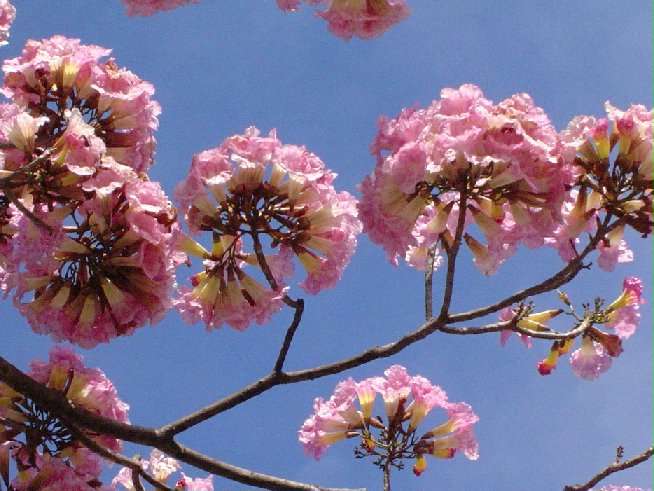
Piúva (Tabebuia heptaphylla)


Quando estiver no Pantanal olhe para as plantas, elas também são uma parte fundamental da vida aqui. Algumas espécies como a Piúva (Tabebuia heptaphylla), Cambará (Vochysia divergens), Acuri (Scheelea phalerata) entre outras são facilmente observadas.
A maior parte das árvores se encontram nos capões, fragmentos naturais de porte mais alto, um belo contraste com a vegetação gramínea.


Acuri (Scheelea phalerata)

Cacho de Acuri

When in Pantanal, take a look to the plants, they have a important function here. Some species like Piúva (Tabebuia heptaphylla), Cambará (Vochysia divergens), Acuri (Scheelea phalerata) are easily observed.
Most part of the trees are concentrate inside “capões” that are naturals fragments with higher canopy, a beautiful contrast with the grassland.


Cambará (Vochysia divergens)

terça-feira, 29 de abril de 2008

Onça Pintada é encontrada na Estrada Parque


Na última semana, o João, um dos proprietários da Xaraés e o André, nosso motorista, dirigindo pela Estrada Parque, observaram um dos mais belos animais do mundo: a onça-pintada. Este é o terceiro maior felino do mundo e podemos encontrar apenas na América do Sul.

Last week, João, one of Xaraés owners and André, our driver, driving through Estrada Parque, saw one of the most beautiful animals of the world: Jaguar. This is the third biggest cat of the world and we can find only in South America.

sexta-feira, 25 de abril de 2008

Alguns animais que são encontrados no entorno da Xaraés

Quati (Nasua nasua)


Periquito Príncipe Negro (Nandayus nenday)


Carreirada


Arara Azul (Anodorhynchus hyacinthinus)


sábado, 19 de abril de 2008

É tempo de Verão!!!!!!!!!!

É tempo de Verão!

Com a chegada do outono e concomitantemente a época de seca, podemos observar agora o Verão (Pyrocephalus rubinus), uma linda e vermelha ave migratória que vem do sul para escapar do frio.

It´s time to Vermilion Flycatcher
Now is autumn, the dry season started and it´s a good time to see the Vermilion Flycatcher, a beautiful and reddish migratory bird that comes from the south to run away of the cold.

Árvores brancas
Preste atenção nos dormitórios das garças brancas grandes e das garças brancas pequenas. Com a chegada do cabeça seca e do colhereiro eles ficarão ainda mais bonitos.

Agradecimento especial para Patricia, Misi e outros hóspedes, pelas fotos.

White trees
Pay atention in the dormitories of Great Egrett and Snowy Egrett. Plus the Woodstorks and Roseate Spoonbill the dormitories will be much more beautiful.
Thanks to Patricia, Misi e other guests for the pictures

Gavião Belo (Busarellus nigricollis) (C) Mihály Bakó, misi at ngo.ro


A Pousada Xaraés agradece o biólogo Pedro Nassar, pelo texto.

sexta-feira, 18 de abril de 2008

RZSS PANTANAL INCIATIVE


The protection of wetlands and related biodiversity is considered of global importance. The Pantanal is the world’s largest freshwater wetland and in recent years it has become increasingly threatened by large development programmes and changes in land management practices. The Royal Zoological Society of Scotland is currently supporting a Pantanal Conservation and Research initiative coordinated by wildlife biologist Arnaud Desbiez to provide scientific research to look for, implement and evaluate conservation actions and sustainable management strategies.
One of the main focuses of the RZSS Pantanal initiative is the development of a rapid method to evaluate and understand resource use of both domestic and wild herbivores. This is particularly urgent since ranching activities in the region are intensifying and destroying important wildlife habitat. RZSS in partnership with EMBRAPA Pantanal (Brazilian government agricultural research corporation in the Pantanal) are collaborating to create this method. They are in the process of completing software based interactive, illustrated key that will identify and characterize the epidermal cells of plant species found in the fecal samples of all plant eating animals. By understanding the botanical composition of plants consumed by both domestic and wild animals, researchers will understand herbivore foraging strategies and their nutritional needs. This information will be used to evaluate the impacts of land management on wildlife as well as to assess and recommend conservation land management strategies that will benefit both cattle and wildlife.